

The History of Bookmaking: From Ancient Rome to Modern Sportsbooks
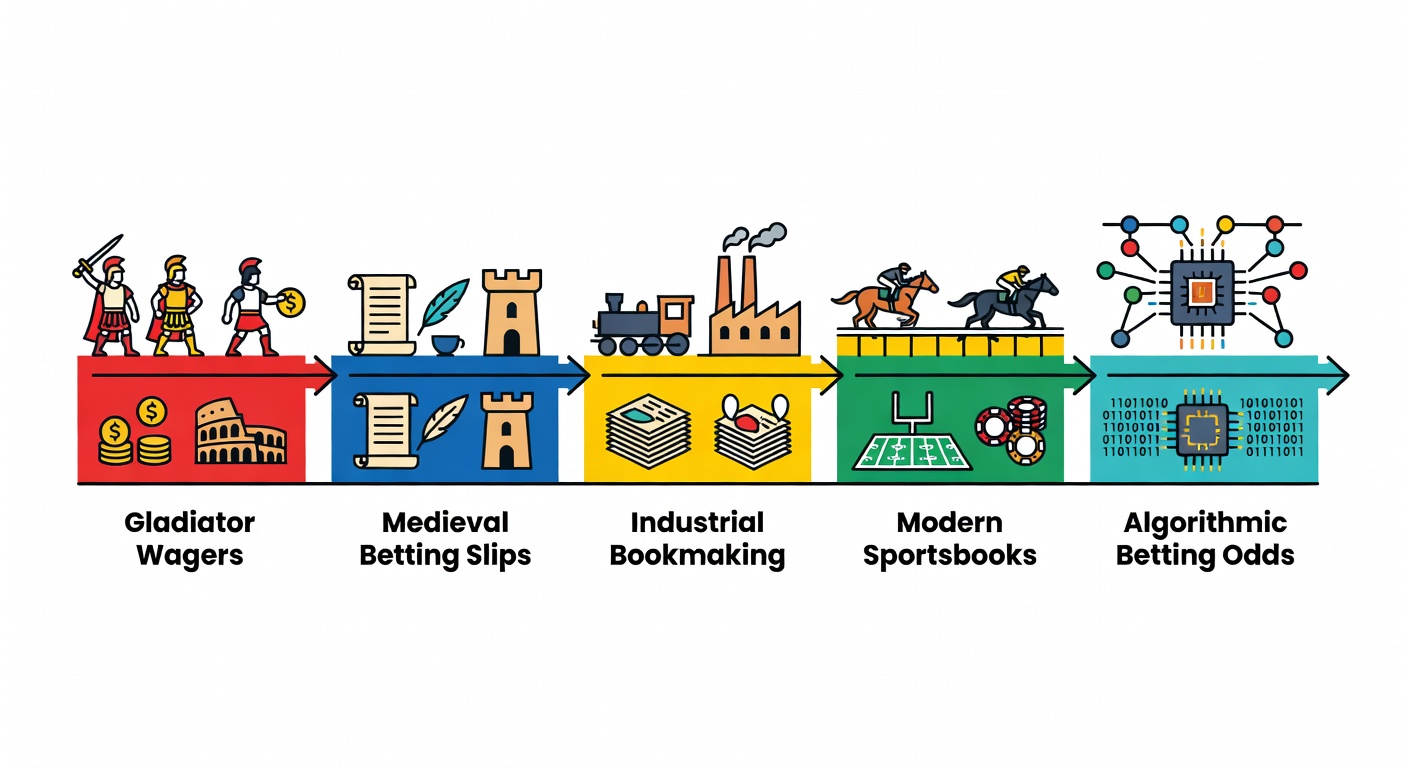
Bookmaking is not a modern invention. Romans placed bets on gladiators. The mechanism has barely changed in 2,000 years.
The Austrian school of economics treats human action as fundamentally about time-preference: the choice between present consumption and future consumption. Gambling is a window into this mechanism. A bettor is purchasing a claim on a future outcome. The price they pay reveals what they believe that future is worth.
The history of bookmaking is the history of how that purchasing mechanism evolved.
Ancient Rome and the Alea
Romans had a game called alea (dice). Betting on alea was widespread. Soldiers bet their pay on dice rolls. Citizens bet on athletic competitions (chariot racing, wrestling).
The bets were informal. Two individuals would agree on odds. If Player A thought a specific charioteer had 60 percent chance of winning, he might offer 3 to 2 odds (meaning if the bet is won, the bettor gets back 3 units for every 2 risked).
This pricing mechanism is identical to modern sportsbooks. The bettor is purchasing a claim on an outcome at a specific price. The person offering the odds (the book maker) is selling that claim.
The Romans understood that if you offered odds that were too generous, you would lose money. If you offered odds that were too stingy, nobody would bet. The equilibrium price emerged from negotiation.
Medieval and Renaissance Betting
During the Middle Ages, betting was often conducted through informal networks. A person would approach a money lender or a merchant and propose a wager. The merchant would quote odds.
The merchant was acting as a "book maker," pricing bets based on their assessment of the outcome probability and their desired profit margin.
In Renaissance Venice, formal betting syndicates began to emerge. A group of wealthy merchants would pool capital and collectively take bets on events (horse races, sailing competitions). The pool would divide profits based on capital contributions.
This is the precursor to modern pari-mutuel betting, where all bets are pooled and redistributed based on outcome.
The Emergence of Mathematical Bookmaking
In the 17th century, mathematical probability emerged as a field. The study of probability, developed by Pascal and Fermat, created a framework for understanding odds mathematically rather than intuitively.
A book maker could now calculate: if a horse has a 40 percent chance of winning (based on historical data), what odds should be offered to ensure a 5 percent profit margin for the book?
Answer: if true probability is 40 percent, fair odds are 2.5 to 1 (a return of 3.5 units for every 1 risked). To ensure a 5 percent margin, offer 2.4 to 1 instead.
This mathematical framework allowed betting to scale. Book makers could now price multiple events simultaneously and adjust odds in real time based on betting volume.
English Horse Racing
Modern bookmaking emerged in England during the 1800s, specifically around horse racing. The sport attracted wealthy spectators and substantial wagering.
English bookmakers developed several innovations:
- The "board" system, where odds were posted publicly rather than negotiated individually.
- The practice of "laying off" bets, where a book maker would hedge their risk by placing counter-bets elsewhere.
- The "vigorish" or "vig," a fixed commission on bets (typically 4 to 5 percent) rather than profit margin based on outcomes.
The vig system was crucial. It meant the book maker could profit regardless of outcome, provided the total vigorish across all bets exceeded their operating costs.
By 1850, the English bookmaking industry had established most of the mechanisms still used today: line setting, line movement based on betting volume, off-track betting through agents, and standardized odds formats.
American Expansion
American bookmakers adapted the English model. They extended it to all sports: baseball, boxing, football.
By the 1920s, bookmaking was a substantial underground industry in the US (illegal in most states). Operators ran "wire services" that transmitted odds and results from central locations to local bookies.
A bettor would place a bet with a local bookie. The bookie would transmit the bet to a central wire service. The central operator would aggregate all bets, set odds, and manage the risk.
This is essentially the same structure as a modern online sportsbook, except the communication was via telegraph or telephone rather than the internet.
The Regulatory Transformation
Before 1995, sportsbooks in the US operated only in Nevada. They were legal, licensed, and regulated by the Nevada Gaming Control Board.
The Unlawful Internet Gambling Enforcement Act (UIGEA) of 2006 criminalized payment processing for illegal gambling. This reduced but did not eliminate illegal bookmaking in the US.
Europe moved toward regulation rather than prohibition. The UK licensed sportsbooks starting in 1960. The MGA (Malta Gaming Authority) began licensing online sportsbooks in the early 2000s.
Regulation created transparency. Licensed operators had to disclose RTP (return to player), margins, and operational practices.
The Mechanism Unchanged
The fundamental mechanism of bookmaking has not changed in 2,000 years. A book maker:
- Assesses the probability of an outcome.
- Prices the bet with a margin (the vigorish).
- Manages risk by adjusting odds as betting volume comes in.
- Profits from the margin, not from predicting outcomes.
A modern sportsbook does exactly this, automated. Software assesses probabilities using historical data and predictive models. Odds are set with a margin (typically 4 to 5 percent for major leagues). Risk is managed through an algorithm that adjusts lines in real time.
The technology has changed. The economics have not.
The Austrian Perspective
From an Austrian economics perspective, the book maker is performing a crucial function: they are pricing time-preference. A bettor prefers a claim on $100 in the future to a certain $40 in the present. The book maker is selling that trade.
The odds reveal the bettor's time-preference and risk-preference. A bettor taking 2 to 1 odds on an unlikely outcome is revealing that they value the future outcome highly relative to the present stake.
The book maker, by offering those odds, is estimating that the market collectively undervalues the future outcome. This is an arbitrage opportunity.
Over time, the odds converge to their true probability (the "closing line value" in betting terminology). When they do, the book maker's margin is the only profit available.
This mechanism has persisted because it is efficient. It allows trades between those who want to sell risk (the book maker) and those who want to buy risk (the bettor). Neither party is exploited, because both can walk away.
The history of bookmaking is the history of how that mechanism became more transparent, more efficient, and more accessible. But the underlying principle remains unchanged.