

Track Conditions and Their Impact on Horse Racing Bets
The condition of the racing surface determines which horses win. Knowledgeable bettors account for this; casual ones do not.
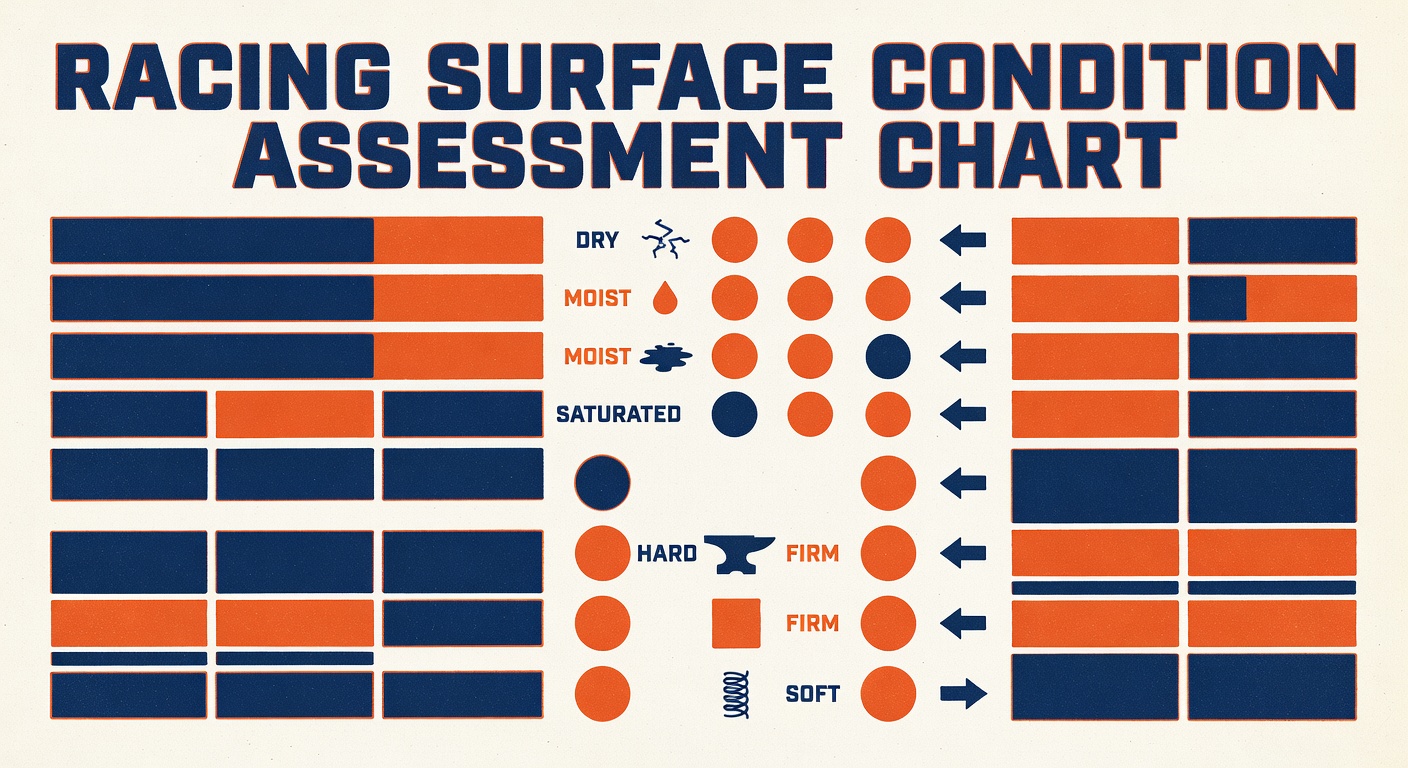
The racing surface at Ascot, Newmarket, or Cheltenham is not a constant. It changes with weather, with use, with maintenance. A firm track plays entirely differently to a soft one. The horse suited to firm ground might be worthless on a bog.
In British horse racing, the official racing authority publishes the track condition before each meeting. The classifications are straightforward: firm, good, good to soft, soft, heavy. Each designation describes the ground's firmness and its consequences for the horses running on it.
A firm track is fast. Horses can move quickly without sinking. The racing suit horses with high speed and low weight. Distance horses (staying types) suffer slightly because the speed game favours pace. Sprinters thrive.
A soft track is slow. Horses sink into the ground. Each stride demands more power. The racing suits horses with strength and constitution. Distance horses improve relative to sprinters. Lightweights struggle because the heavier they are relative to ground resistance, the better they perform.
Heavy ground is the extreme. It is waterlogged. Some horses simply cannot cope. You see withdrawal rates increase. Trainers keep horses out rather than risk injury or terrible performance.
The Betting Implications
A seasoned punter accounts for track condition when assessing odds. A horse listed at 8-1 might be worth betting at 7-1 if the ground is currently firm but forecasted to soften to soft by their race. That horse improves on soft ground relative to the current favourite, whose odds have not adjusted for the expected change.
The odds available reflect the crowd's assessment of track condition at the time of betting. If the crowd underestimates the impact of changing ground on a particular horse, the odds create an opportunity.
Consider a horse trained by a yard known for heavy-ground specialists. The ground is currently soft; racing today saw good performances from pace horses. Tomorrow's forecast is heavy rain. That trainer's horse, running tomorrow, is likely underestimated in the odds because the crowd is still mentally adjusting to today's fast racing.
The Data Point
The racing authorities maintain records of every horse's performance on every type of ground over their career. These are publicly available. A professional bettor will cross-reference a horse's record on firm ground versus soft ground versus heavy ground.
Some horses show a clear preference. A horse with a record of 3 wins from 5 runs on firm ground but 0 wins from 8 runs on soft ground has a concrete disadvantage if the going turns soft. The odds do not always reflect this specificity.
Other horses are what is called "all-weather" performers: they run well regardless of ground. These horses are versatile but often less spectacular because versatility trades off extreme excellence in any single condition.
Reading the Forecast
The Met Office and the racing authorities publish ground condition forecasts. A punter with access to these forecasts can identify horses whose preferences align with the expected ground several days in advance, before the crowd has fully repriced them.
If heavy rain is forecasted and the ground is currently soft, a trainer might withdraw their good-ground horse and declare their heavy-ground horse instead. This information, once it becomes public, reprices the market. But there is often a lag between the forecast and the market adjustment.
A single percentage point increase in the probability of a horse winning, due to ground condition, can create an overlay in the odds.
The most profitable bets come from information asymmetries: you know something the crowd does not, or you are right about something the crowd is wrong about. Ground condition preferences create these asymmetries regularly because the data is public but not always integrated into the odds.
The Professional Approach
A professional racing bettor keeps detailed records: not just wins and losses, but how the horse performed relative to its past performance on similar ground. They track trainers' ground preferences. They note which horses improve dramatically on specific going and which ones are overrated on any ground.
When a meeting is forecasted to have a sudden change in ground condition, they review the entries and identify the mismatch: horses with strong records on the expected ground but entered in a field of horses suited to the current ground. These are candidates for value bets.
The casual bettor sees a 5-1 shot and asks: "Do I think this horse will win?" The professional bettor sees the same horse and asks: "Is 5-1 fair odds given the track condition and this horse's performance history on this type of ground?" That second question, asked rigorously, is the difference between gambling and betting.