

The Patricia DeMauro Craps Roll: 154 Rolls Without a Seven-Out
On May 23, 2009, Patricia DeMauro walked into the Atlantic City Borgata and rolled the dice for 4 hours and 18 minutes without sevening out.
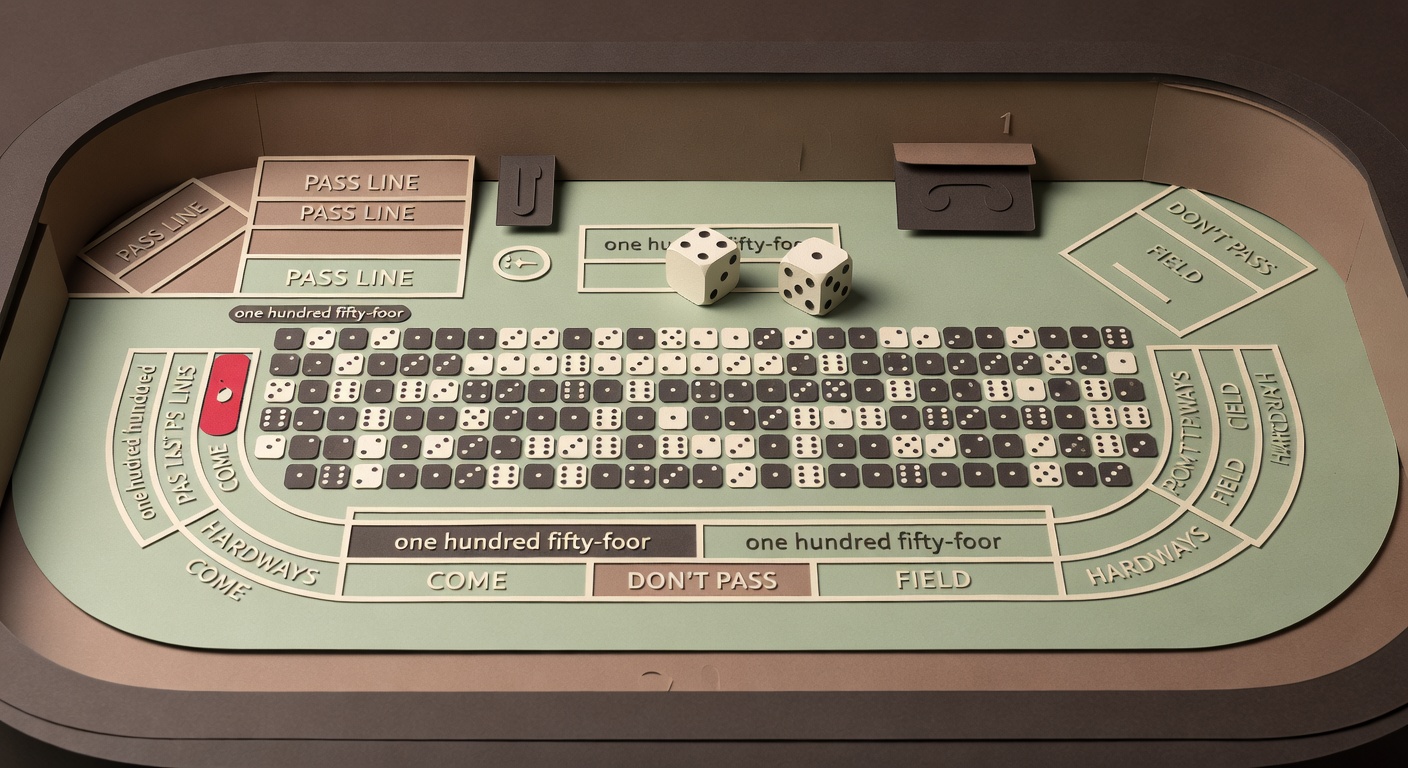
On May 23, 2009, Patricia DeMauro walked into the Atlantic City Borgata and rolled the dice for 4 hours and 18 minutes without sevening out. She rolled 154 consecutive times without rolling a seven with the point established. The longest known craps roll in recorded history.
The probability of rolling 154 consecutive non-seven rolls is 1 in 5.6 billion, assuming a fair die and random outcomes.
DeMauro was a 61-year-old grandmother. She had never shot craps before. She was on her first ever trip to Atlantic City, covering for a friend at a craps table they had booked. She rolled.
The Math
Craps is a specific game. The shooter establishes a point (a number from 4 to 10). The shooter then keeps rolling until they either roll the point again (a win) or roll a seven (a loss, called a seven-out).
Once a point is established, the probability of rolling a seven is 6/36, or 1/6 (six ways to roll a seven out of 36 possible combinations). The probability of rolling anything other than a seven is 5/6.
For 154 consecutive rolls without a seven: (5/6)^154 = 5.56 × 10^-9
That's one in 1.8 billion.
Actual casino surveillance footage confirmed every roll. The Borgata's pit boss, the boxman, and the stickman all documented the roll in real time. No die substitution. No two-handed shots. One shooter, 154 rolls, no seven.
The Variance
At a craps table, variance is everything. The house edge on the pass line is 1.41 percent. This is the long-term mathematical advantage. But in the short term, one shooter can produce massive swings.
DeMauro's roll lasted 268 minutes. During that time, let's estimate the table made 2,000 bets (a conservative guess, some craps devotees bet heavily). If the average bet was $15, the table moved $30,000 in total action.
With a 1.41 percent house edge, the Borgata should have won $424. Instead, for those 4 hours, the table was in favor of the pass line betters. DeMauro's roll beat the Borgata by an estimated $8,000 to $15,000 depending on the actual bet distribution.
However, the Borgata made more money from that roll than from 50 ordinary dice. The crowd grew. People were betting heavier. The news value alone was worth more than one day's revenue.
The Misconception
Claim: Patricia DeMauro proved that craps is a beatable game.
Reality: She proved that a 1-in-1.8-billion variance exists. Nothing more. One roll, however improbable, does not change the house edge. The Borgata's 1.41 percent advantage over 10,000 rolls would have erased any short-term gain from DeMauro's roll. The very next shooter probably produced a seven-out in 10 rolls.
People look at DeMauro's roll and see proof that luck matters. It does. Luck matters for every roll. But over time, luck averages out. The house edge is what remains.
Craps is not a game where you can find an edge. The game mechanics are pure chance. The only advantage available is skill in money management (bet sizing, position, knowing when to walk) and discipline. No shooter can beat the math of craps forever.
Sample Size
The DeMauro roll was examined by multiple analysts. One craps expert, William Coveyou, estimated that a comparable roll happens roughly once every 500 million hours of casino craps play. Atlantic City alone runs 24-hour craps maybe 8 hours a day on average (casinos have multiple tables but not all run 24/7). That's 2,920 hours per year.
For one casino, one legendary roll every 171,000 years of operation.
But globally, with hundreds of casinos, hundreds of thousands of amateur dice games, the odds compress. Over 80 years of modern casino gambling, seeing one 150+ roll is actually within the realm of expectation. Two rolls of this magnitude would suggest cheating. One roll is variance.
The Narrative
DeMauro's roll became famous because the narrative is irresistible. A first-time player beats impossible odds. The grandmother walks away with a story for life. The Borgata gets free publicity worth millions.
But the mathematical reality is simpler: one improbable event happened. It will happen again, sometime, somewhere. When it does, someone will use it to argue that luck is learnable.
It is not. Luck is variance. The DeMauro roll was variance manifested. It tells us nothing about the game of craps except that variance exists. The house edge is still 1.41 percent. The next shooter will probably seven-out in 10 rolls. The table will grind on.
DeMauro was the beneficiary of a legitimate 1-in-1.8-billion event. She was not special. She was statistically improbable. For a moment, she was lucky. That's all the craps table offers anyone.