

Beat the Dealer: Edward Thorp's Book That Changed Gambling
In 1962, a mathematics professor published a book explaining how to count cards in blackjack. The casino industry has never recovered.
Edward Thorp was a mathematics professor at MIT. In 1962, he published a book called Beat the Dealer that explained, in precise mathematical terms, how a player could gain an edge over the house in blackjack by tracking the composition of the remaining deck. The book was not written for insiders. It was written for the public.
The impact was immediate and catastrophic for the industry. Within two years, blackjack tables across Las Vegas began implementing countermeasures. Multiple decks became standard. The dealer's hole card was partially burned before dealing began. The shoe was shuffled every 30 cards instead of every 75. Casinos began hiring surveillance teams specifically to identify card counters. Thorp had given the entire gambling public a roadmap to an advantage game.
What Thorp understood, and the casinos did not, was that blackjack is solvable. The game has perfect information available (you know your cards, you know the dealer's up card). You can calculate the probability of the dealer busting for any given hand. You can calculate the expected value of hitting versus standing. And most importantly, you can track which cards remain in the deck, and adjust your strategy based on that information.
Before Beat the Dealer, casinos operated on the assumption that blackjack was a house-edge game that favored the casino by about 2 percent. That math is still correct for a basic strategy player (someone who hits and stands according to a fixed chart). But it is not correct for a card counter. A card counter can achieve a 0.5 to 1.5 percent advantage over the house by the end of a shoe.
The Mechanics Thorp Explained
The core idea is simple. In an unshuffled deck, small cards (2 through 6) are "bad" for the player because they help the dealer. Large cards (10 through Ace) are "good" for the player because they create blackjacks and stiff hands for the dealer. By tracking how many high cards remain in the shoe, you can increase your bet size when the shoe is favorable. When the shoe is unfavorable, you make the minimum bet.
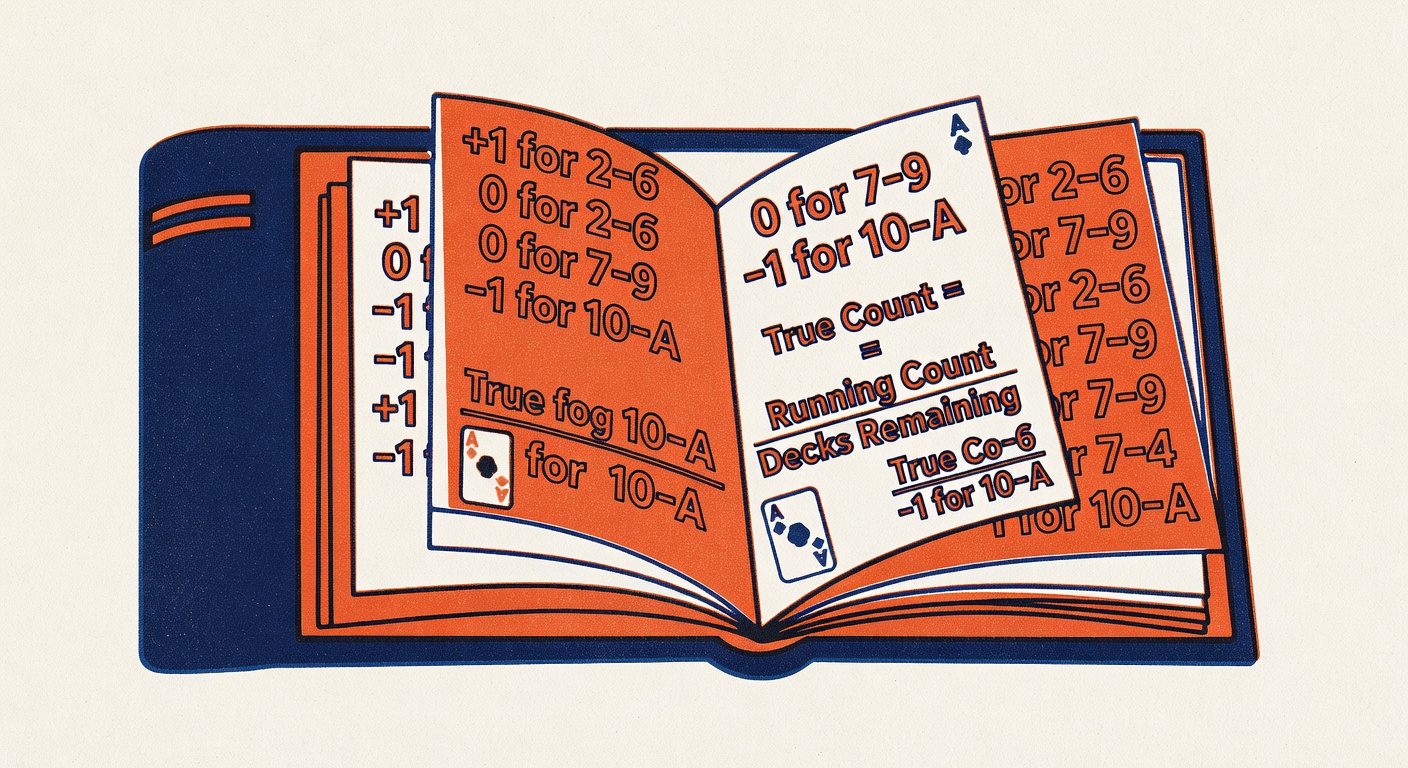
Thorp developed what he called the "Hi-Lo count." Every time a low card was dealt, he subtracted 1 from his count. Every time a high card was dealt, he added 1. Neutral cards (7, 8, 9) he left alone. By dividing this count by the number of decks remaining, he could estimate the "true count" and adjust his betting accordingly.
The book came with tables, examples, and specific strategic deviations. It was not mystical. It was mathematics, written in English, explaining why casinos had been losing money to a predictable pattern they had not noticed.
The casinos responded by changing the game. Multiple decks meant the count reset faster. A cut card inserted 75 percent through the shoe meant fewer hands were played in the favorable deck composition. Later, they added continuous shuffling machines that shuffled every hand, making counting impossible. The industry basically said: We will change the game rather than allow an advantage player to exist.
What Thorp had demonstrated was that the casino's house edge is not magical. It is mathematical. And mathematics can be beaten by better mathematics. This terrified the industry.
The secondary legacy: Thorp's book inspired decades of counting-system development. MIT teams in the 1970s and 1980s refined counting techniques and bankroll management. The movie 21 (2008) was based on these MIT card-counting teams, though the film took considerable liberties with the actual events.
Thorp's book also established the principle that the casino has the right to refuse service. Casinos began banning known counters. Pit bosses were trained to identify counting tells (consistent bet sizing regardless of count, deviations from basic strategy on certain hands). The surveillance arms race began.
The larger historical point: Thorp showed that games of chance are often games of incomplete information to the casinos, but not to the informed player. If the game can be fully analyzed, and the deck composition tracked, then the game can be beaten. This insight has driven development in every aspect of advantage gambling since: poker, sports betting, even slot machine analysis (mostly unsuccessful, given the RNG).
Beat the Dealer remained in print. Casinos never recovered from it. They adapted. They hired mathematicians. They built better surveillance. But they never again assumed that their house edge was unbeatable. Thorp had proven it was not.