

Shuffle Tracking: Is It Still Possible in Modern Casinos?
Shuffle tracking is the practice of following a specific subset of cards through a shuffle. If you can identify where the high-card clump ends up after the…
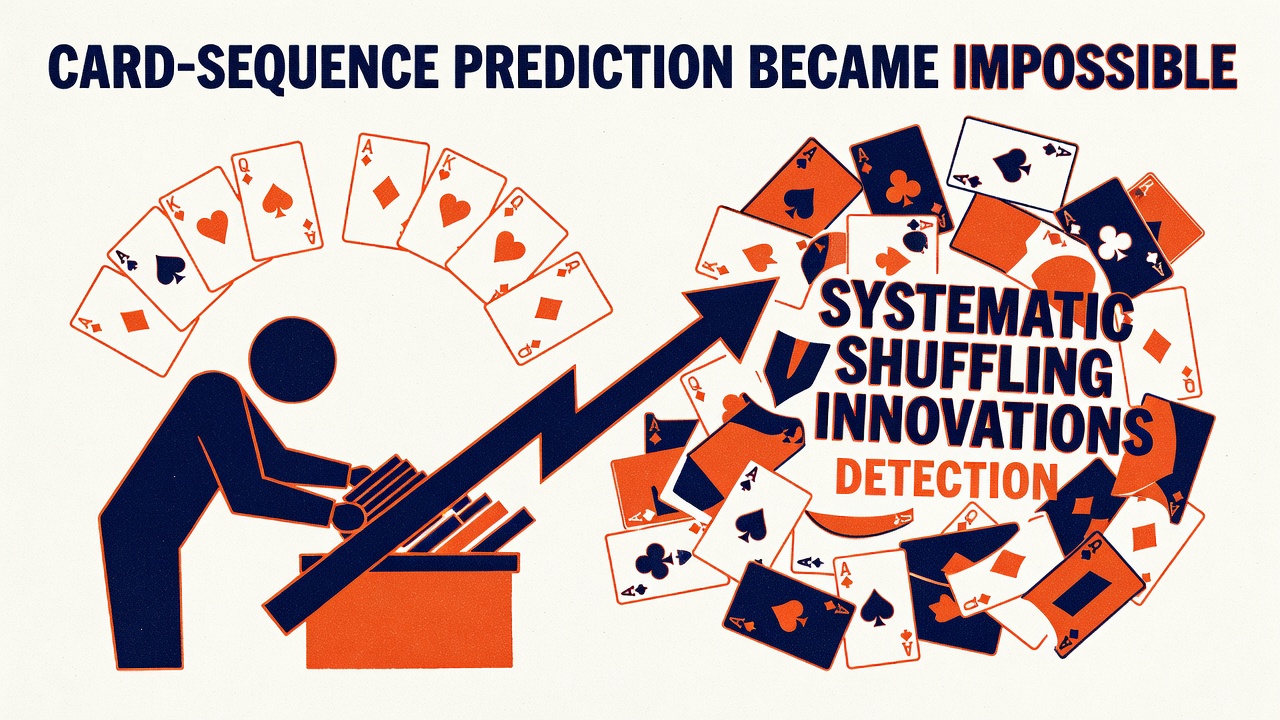
Shuffle tracking is the practice of following a specific subset of cards through a shuffle. If you can identify where the high-card clump ends up after the dealer shuffles, you can predict with rough accuracy whether the next shoe will be favorable. It was real. We caught people doing it. Then we changed the rules.
Here is how it worked in theory. You notice that from cards 15 through 30 in the shoe, there are fifteen ten-value cards and only five low cards. That is a clump. If you can track where that clump goes after the shuffle, you know that when the cut card lands in that section, the shoe will be favorable to the player. You increase your bet. You win more hands. You leave.
The difficulty is that a professional shuffle is designed to prevent this. The dealer is trained to riffle-shuffle the cards in a way that disperses clumps. But human dealers are fallible. Some shuffle mechanically. Some shuffle the same way every time. Some shuffle fast because they want to get through their shift. A skilled observer can track cards through a weak shuffle.
The old response was surveillance. We would watch for players who suddenly increase their bet right before a favorable shoe. We would look for players whose eyes tracked the shuffle. We would identify the people who were counting cards and then escalate to identifying the people who were tracking specific clumps.
But the easier response was to remove the humans from the equation.
The Fix
Most casinos that care about preventing advantage play use one of two technologies. The first is the continuous shuffler. It is a machine that automatically shuffles returned cards back into the deck in real-time. No defined shoe. No clump. No shuffle to track. The shoe is always mixed. Advantage play becomes impossible.
The second is the eight-deck shoe with an aggressive cut card placement. Seventy-five percent of the shoe is played out. Only twenty-five percent remains. The advantage of even a favorably-composed remaining shoe is minimal because there is so little of it. And the faster shoe means more hands per hour, which is better for the house even if individual hands are slightly more favorable to the player.
We implemented both of these at the casino I worked at starting in 1998. By 2005, approximately sixty percent of blackjack tables were using either continuous shufflers or eight-deck shoes with cut cards at seventy-five percent penetration. By 2015, it was ninety percent.
Shuffle tracking as a viable advantage-play method died because we made it die. It was not expensive. It required operational changes but no new regulation. We simply made the game harder to beat.
The reason we did this was because good shuffle trackers were winning approximately 1.5 percent per hand on the shoes they could read. Applied across a thousand hands per night per table, that is fifteen hands won due to superior information. The variance on that is small enough that a skilled tracker could make it reliable. So we eliminated the information advantage.
Today, if someone claims they are a shuffle tracker, they are either lying or they are in one of the small percentage of casinos that still uses loose shuffling procedures. The small casinos, the casinos in jurisdictions with light regulation, the casinos that cannot afford continuous shufflers; those places sometimes have weak shuffles.
But in Nevada, in Atlantic City, in major jurisdictions with real oversight, shuffle tracking is functionally dead. We made sure of it.
The people who tried to beat us on shuffle tracking were clever. Some of them were mathematicians. Some of them were ex-dealers who understood the mechanics inside out. We respected the skill. But we also respected the business requirement: the house must maintain a mathematical advantage. If an informational asymmetry emerged, we would close it. If it required new machines, we bought new machines. If it required new procedures, we implemented them.
Shuffle tracking is history now. It is a story that advantage players tell at the bar. "Back in the 80s, you could track the cards through the shuffle." It is true. It was possible. We are no longer going to let it happen. That is the real story.