

How Low-Bandwidth Live Dealer Streams Affect Gameplay
Bad internet doesn't just make a video pixelated. It kills the synchronization between player input and dealer action, creating a window where the outcome is already set.
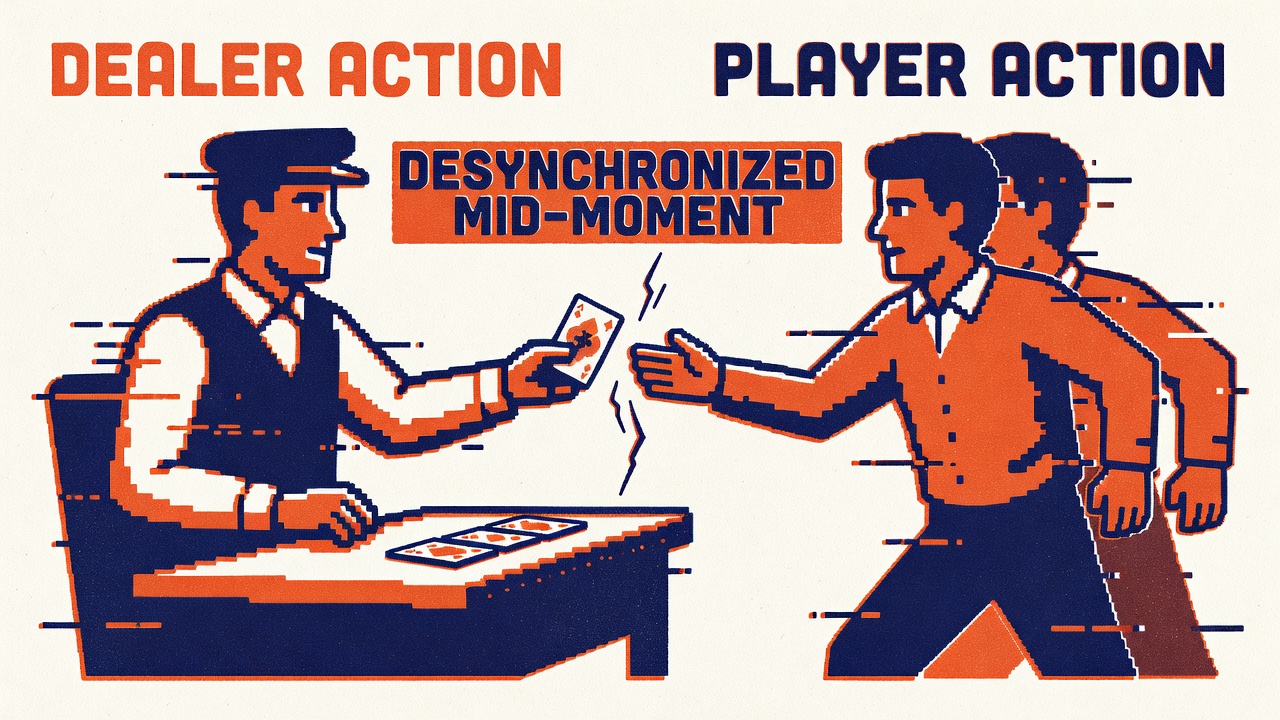
In 2018 a fraud ring operating from a basement apartment in Bucharest discovered something important: a two-second lag in a live roulette stream. The dealer had already released the ball. The ball had already come to rest. But the player's click to place a bet still registered as if it landed before the spin was locked. The operators made $47,000 before a Sharp-eyed accountant at the aggregator noticed two identical bets placed on consecutive spins with impossible timing.
Live dealer games run on a system that looks deceptively simple but depends on millisecond precision. The dealer is in a studio, possibly in Malta or Curaçao. The player is sitting in Copenhagen or Singapore. The video feed travels one way. The player's bet submission travels another. The dealer's actions are bound to a timestamp on a server that both systems check. When bandwidth is low, that chain breaks.
How the Video Stream Connects to Game Logic
Most people think the issue is just picture quality: pixelation, freezing, dropped frames. That's annoying but survivable. The real problem is something called "glass-to-glass latency", which is the time between when the dealer's hand moves and when the player sees that movement on their phone. On a fast connection, it's 800 milliseconds to 1.2 seconds. On a compressed or throttled connection, it can stretch to 4 or 5 seconds.
Here's where the fraud door opens:
- The player sees the dealer place the roulette wheel
- But the server has already locked the bet window
- The player thinks they have time to bet
- Their bet gets rejected, or worse, it gets accepted retroactively
- The player believes their action mattered; the house knows it didn't
Legitimate operators solve this by syncing a timestamp to the player's device at the moment the bet window closes. If your click arrives after that timestamp, it's refused. But some operations, especially in less-regulated jurisdictions, don't bother with that sync. They rely on the delay itself.
I watched a case in 2011 where a small Kahnawake-licensed site running on substandard infrastructure experienced what they called "connection storms." During peak hours, video would lag three to five seconds behind actual dealer action. Players complained. The operator's response was to lower minimum bets on high-lag connections, a move that sounds charitable but was pure math: they knew exactly which players were seeing delayed feeds and had configured the backend to offer them worse odds without disclosure.
The Edge Cases That Matter Most
Mobile users on 3G or shared WiFi are the vulnerable population. If you're playing on a coffee-shop WiFi that also has 40 other users, your bandwidth isn't guaranteed. A good operator buffers video anyway: they accept some lag as inevitable and build the system around it. A lazy operator doesn't. They count on you not noticing that your bet sometimes lands after the hand is already resolved.
Speed roulette and auto roulette are especially sensitive because there's no human downtime. In a traditional live roulette game, the dealer spins the wheel, releases the ball, then sits back. There's a natural pause where everyone knows the bet window is closed. In automated roulette, a wheel spins and locks in 15 seconds flat. If your stream is four seconds behind, you miss the entire second half of the window.
The thing I learned investigating this stuff: most players blame themselves. They think their connection is bad so they accept the loss. Some operators count on exactly that psychology.