

Live Baccarat Strategies: Banker, Player, or Tie Bet?
Baccarat offers three bets. The mathematics are brutal for one of them. The choice between the other two is subtle.
I spent fifteen years driving rental cars from casino to casino. I knew the inside of a blackjack shoe better than I knew my own living room. Blackjack is a game where you can grind an edge. Baccarat is different. Baccarat is a game where the edge grinds you.
Let me explain the bets. In baccarat, you bet on the banker hand, the player hand, or a tie. The dealer deals two cards to each. Face cards and tens are worth zero. Other cards are face value. Aces are one. If your hand totals more than nine, you drop the first digit (sixteen becomes six). Highest hand wins.
Banker pays 1:1 minus a 5% commission (you get 0.95 for every dollar bet). Player pays 1:1 even money (you get 1:1). Tie pays 8:1 or 9:1 depending on the casino.
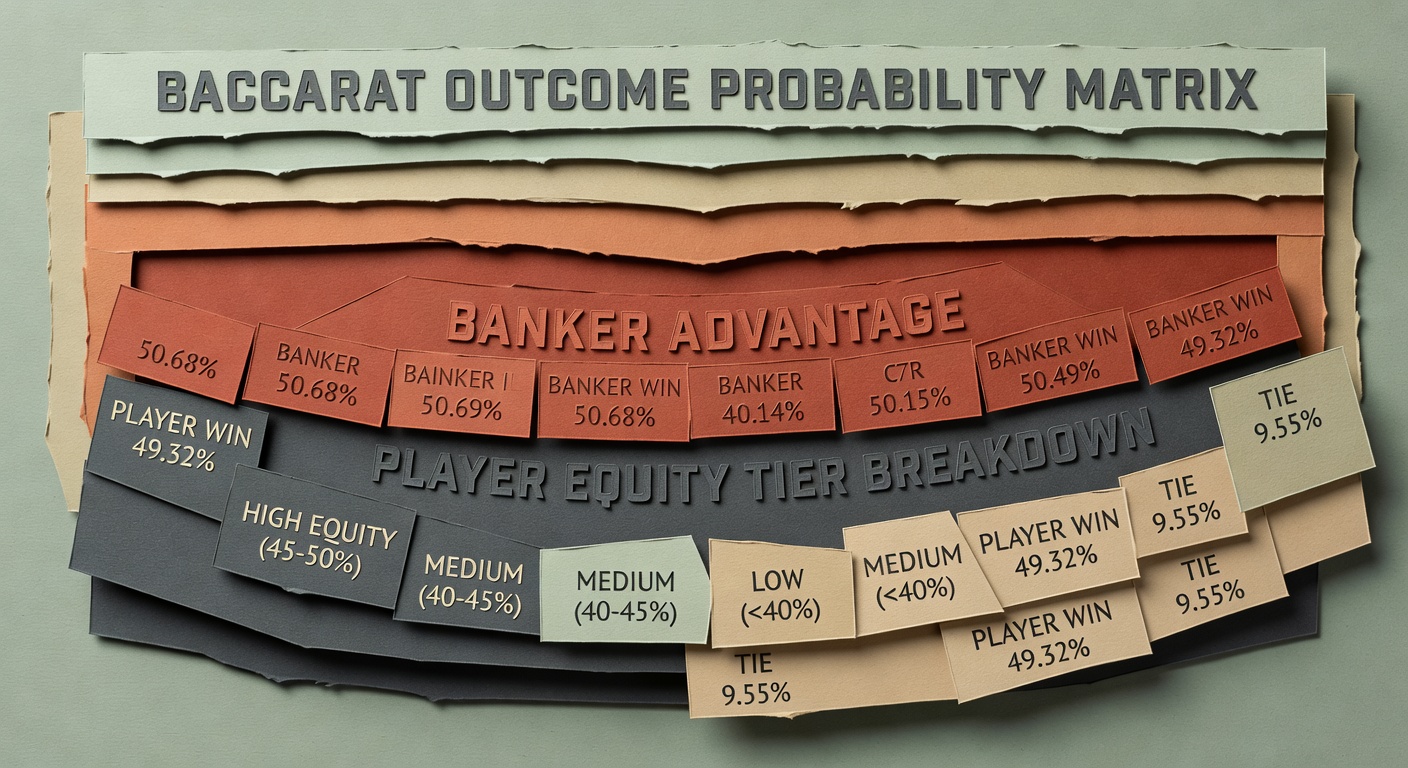
The banker hand wins 50.68% of the time (excluding ties). The player hand wins 49.32%. The tie occurs 9.52% of the time. When you account for commissions, banker has a 1.06% edge on your money. Player has a 1.24% edge on your money. Tie has a 14.36% edge.
The Tie Bet
Do not bet the tie. Ever. The payout sounds good (8 or 9 to 1) but the odds are terrible. You win roughly 9.5% of the time. At 8:1 payout, your expected return is 0.095 multiplied by 8, which is 0.76. You lose 0.24 cents on every dollar. That is a 14.36% house edge. It is like lighting your money on fire at a slower rate than usual.
Some casinos advertise tie pays 9:1. That improves your expected return to 0.095 multiplied by 9, which is 0.855. You still lose 14.5 cents per dollar. The tie is a sucker bet. Treat it as forbidden.
Banker vs Player
The choice between banker and player is not where the edge is won or lost. Both bets have a house edge. But banker has a slightly smaller house edge than player.
If you are going to be at a baccarat table losing money anyway, you may as well minimize the rate of loss. Banker is 1.06% versus player at 1.24%. Over a thousand hands, the difference amounts to substantial money.
Some players avoid banker because they resent paying commission. They want to feel like they are getting full odds. But this is pure psychology. Commission is built into the math. Banker is the correct bet if you are forced to choose between banker and player.
The Pattern Trap
Baccarat encourages tracking the pattern of results. You see a road map: banker, banker, player, player, banker. The inclination is strong to believe that patterns contain information. They do not.
Baccarat is close to a coin flip (bankier is slightly more likely, but not dramatically). Each hand is independent. The previous result does not predict the next result. Following the pattern is a known cognitive bias that costs money.
I sat at baccarat tables with people who kept elaborate scorecards, tracking which had won more, whether banker was due. These people lost money consistently. Not because the strategy was bad; there is no strategy. But because they were paying attention to the wrong thing.
The Live Dealer Advantage
Live baccarat, with a real dealer and real cards, is identical mathematically to virtual baccarat. The only advantage of live is psychological: you can see the cards dealt, you can be certain there is no random-number trickery, and you feel connected to the game.
If this costs you extra in the form of higher house edge or slower play, skip it. If the odds are the same, choose based on comfort. The math does not change.
The Bankroll Reality
Baccarat is a game of pure luck with a fixed house edge. You will lose money in expectation. The only variables that matter are: how long you play (more hands, more losses) and how much you bet (larger bets, larger losses).
The strategy is bankroll management and quitting. Set a loss limit. If you want to win money, do not play baccarat. If you play baccarat for entertainment, understand that you are paying for that entertainment at a rate of 1.06% per unit of bankroll spent.