

Know Your Customer vs Enhanced Due Diligence: Key Differences
Know Your Customer (KYC) and Enhanced Due Diligence (EDD) are two tiers of verification, each designed for different risk levels. Understanding their practical differences explains why some players face friction casinos never mention.
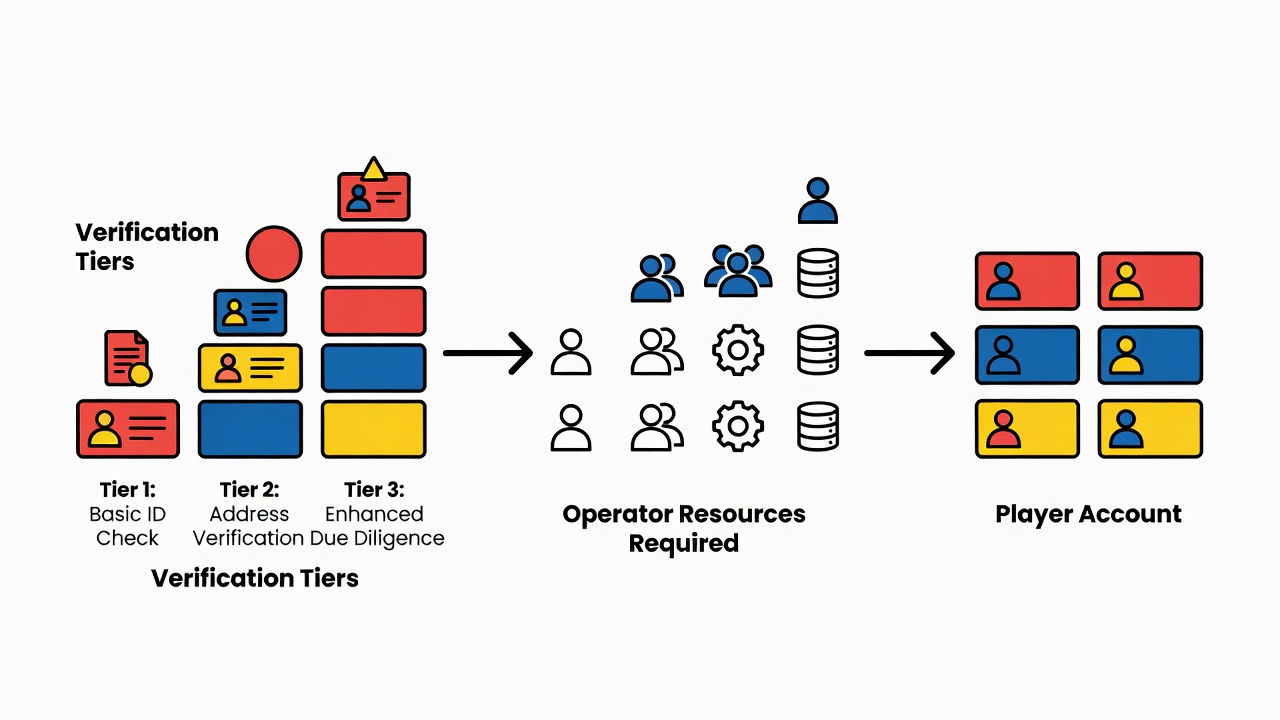
A player sits down to open an account at an online casino. The casino asks for their name, address, and identification number. This is Know Your Customer, or KYC. It is the legal minimum in most regulated jurisdictions. The casino verifies the information through a third-party verification service. The verification takes minutes. The account opens. The player deposits money and plays.
A different player opens the same casino. The casino asks the same questions, but this time the process does not end there. The casino requests additional information: source of funds documentation, recent bank statements, possibly an interview or video call. The casino contacts the player's bank to verify account details. The casino checks international sanctions lists for the player's name. This process takes days or weeks. This is Enhanced Due Diligence, or EDD.
Why the difference? The answer lies in risk. The casino must assess whether the player is a legitimate person with legitimate funds, or whether they are a proxy for money laundering, sanctions evasion, or terrorist financing. KYC handles the baseline case: most people are legitimate. EDD handles the elevated-risk case: some people require deeper verification. The casino makes this determination based on rules set by their regulator and their own compliance program.
When KYC Is Applied and When It Isn't Enough
KYC verification typically requires:
- Full name, date of birth, address
- Government-issued identification (passport, driver's license, national ID)
- Proof of address (recent utility bill, bank statement, rental agreement)
- Social security number (in the United States)
- In some jurisdictions, proof of source of funds from the first deposit
The verification happens at account opening and is valid unless the casino suspects a problem. If a player later deposits very large amounts, or makes a transaction pattern that flags a compliance rule, the casino may escalate from KYC to EDD retroactively.
EDD applies in several specific scenarios. The casino must conduct EDD if the player is a Politically Exposed Person (PEP), which means a current or former government official, their immediate family members, or individuals known to have close associations with such officials. If a player is from a high-risk jurisdiction, EDD applies. If the player's deposit is unusually large relative to their stated income, EDD applies. If the player's transaction pattern suggests potential money laundering (rapid deposit, rapid withdrawal, movement of funds to another player's account), EDD applies.
The practical result: a player might open an account and play for months under KYC verification, then suddenly face EDD requests when they request a large withdrawal. The casino has not changed the rules. The casino's regulator requires this escalation based on the withdrawal size and circumstances. The player experiences this as friction or obstruction, but it is actually a compliance obligation.
The Architecture of Verification
Casinos use third-party verification services to conduct both KYC and EDD. Companies like Veriff, iDenfy, and Onfido provide automated identity verification for KYC. These services take a photo of a government ID, compare it to a selfie using facial recognition, and issue a verification result in seconds. This is fast and automated. Most players never notice it.
EDD requires human review because the decision trees are more complex. A compliance officer must read the supporting documents, check the sanctions lists, assess the risk profile, and make a determination. This is expensive and slow. A casino processing EDD for a $250,000 withdrawal must be prepared to spend several hours of compliance officer time per case.
Magna Europa, the Malta-based operator, reported in 2019 that EDD verification was costing them approximately $500 per case in administrative expenses. For players requesting withdrawals under $5,000, EDD was rarely triggered. For players requesting withdrawals over $100,000, EDD was nearly universal. The reason: regulatory cost-benefit. The regulatory risk of failing to verify a high-value withdrawal exceeds the operational cost of doing EDD.
From the player's perspective, KYC feels like a formality. EDD feels like interrogation. But both exist because regulators view them as necessary to prevent the financial system from being used for harm. The casino is the enforcement point. The player is the subject of that enforcement.