

How Dealers Shuffle Cards: CSMs vs Manual Shoes
A deal at Desert Inn in 1984 meant watching Eddie, the pit boss, run a shoe through the shuffle machine three times before dealing began. Forty years later, we still can't agree on whether machines or hands do the job better.
Eddie wore a gold watch on his right wrist and he never took it off, even when he was shuffling. That watch caught the light. When he brought the cards up, before the shuffle, before the deal, you knew the shoe was genuine in his possession. You knew a human was managing the situation.
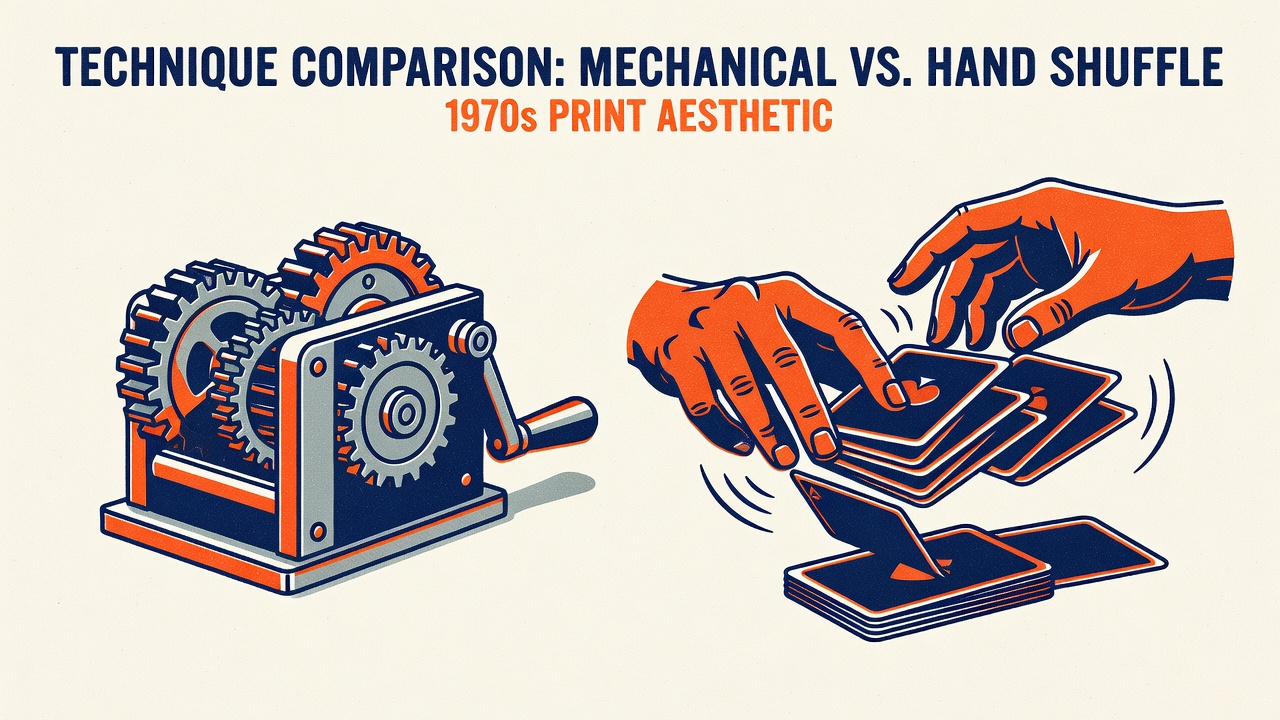
That was 1984. In 2024, a dealer at the Cosmopolitan reaches for a card shoe, shuffles twice, positions the cut card, and commences dealing. At select establishments, though, the dealer never touches the cards again. A CSM (a continuous shuffling machine) assumes responsibility. Feed the cards in. The apparatus randomizes them. The apparatus returns them. The dealer's hands remain available. Eddie wouldn't recognize the activity.
Establishments contend CSMs excel. Mathematicians advocate for manual shoes. The reality is that nobody reaches consensus because superior means different things based on perspective.
The Advantage of Machines
A CSM eradicates card counting. This isn't marginal. It constitutes the entire justification for acquiring a CSM. During the seventies and eighties, card counters presented genuine difficulty. They could track the deck's composition and magnify their advantage measurably. MIT squads, professional counters, individuals who had genuinely studied the mathematics. Establishments hemorrhaged millions.
A CSM eliminates this peril absolutely. Every hand gets dealt from a randomized shoe. The deck's composition remains untrackable because randomization happens continuously, sometimes after individual hands, sometimes after pairs, depending on apparatus specifications. This represents absolute security from the house perspective.
However there's a drawback. The perpetual shuffle means penetration (the percentage of the deck getting dealt before reshuffling) approximates zero. In a manual shoe, a dealer might dispense 75 percent before reshuffling. In a CSM, penetration might reach 5 percent. Diminished information exists for players attempting decisions contingent on residual deck composition.
A card counter in 1979 might achieve 20 percent above basic strategy in a single deck game with strong penetration. That identical counter at a CSM installation earns nothing. The establishment didn't eliminate a patron; the establishment destroyed an entire advantage-play category. (MIT Blackjack Team member, retired, 2015)
The Advantage of Manual Shoes
Manual shuffles generate pacing. A dealer shuffles, severs the deck, incinerates a card, distributes. The procedure requires a minute. The procedure shows. The participant comprehends what's transpiring. When a card remains hidden, the participant recognizes the dealer determines its destination.
A CSM remains mysterious. Cards enter. Cards depart. Randomization stays obscure. Participants resent it. They distrust it. This isn't necessarily logical. The CSM moves faster and protects better, yet confidence isn't logical. It's subjective. A participant at a manual shoe feels comprehension. A participant at a CSM station feels they're contending with a device.
Manual shoes additionally provide inferior penetration, suggesting decelerated anticipated losses for the participant. In a six-deck manual shoe with 75 percent penetration, the establishment's advantage reaches roughly 0.5 percent. In the equivalent game with CSM, the advantage stays roughly identical, however participants hemorrhage faster because rounds accelerate and shuffling diminishes.
The Human Cost
Dealing constitutes labor. Eddie functioned as a pit boss, yet commenced as a dealer. A dealer managing manual shoes gets extra responsibility. They shuffle, sever, distribute, manage the table's pacing. A dealer managing a CSM executes protocols. Feed the shoe. Dispense cards. Accumulate cards. Iterate.
This substance matters because dealers constitute individuals and individuals crave feeling valuable. A dealer at a manual shoe experiences agency. A dealer at a CSM experiences they're administering machinery. The occupation transforms. The compensation remains constant.
Establishments have designated CSMs at roughly 60 percent of installations and manual shoes at 40 percent. The determination isn't arbitrary. Exclusive rooms utilize manual shoes because affluent players require the activity seems human. Mass-participation sections utilize CSMs because the mathematical advantage surpasses the experience improvement. Revenue versus belonging. The establishments discern which prevails.
Eddie retired in 1991. Should he walk into an establishment nowadays and encounter a CSM, he'd probably locate a manual shoe instead. Not because the CSM performed inadequately. Because he yearned to observe a person executing the responsibility. That yearning is what the CSM replaced.