

Using Crypto for Poker Deposits and Withdrawals
I met a guy in a poker room in Mexico, 2015, and he was like, I only play on Bitcoin sites now. I asked him why and he spent 45 minutes explaining.
So I am sitting in this card room in Puerto Vallarta, Mexico, 2015, right, and there is this guy from Montreal at my table who keeps going on about Bitcoin poker. I did not think much of it until the end of the night when he needed to take a screen shot of his account on his phone because he was transferring money to his home game. The screenshot showed a Bitcoin wallet. Everything in the wallet was crypto. I asked him why, and he said, "Because the banks cannot freeze it."
That stuck with me. I got interested. Started playing on some Bitcoin poker sites. Sites like Unibet and Betonline had already added Bitcoin by then. But the Bitcoin thing did not really make sense until 2017 when the poker ban stuff was happening in certain countries.
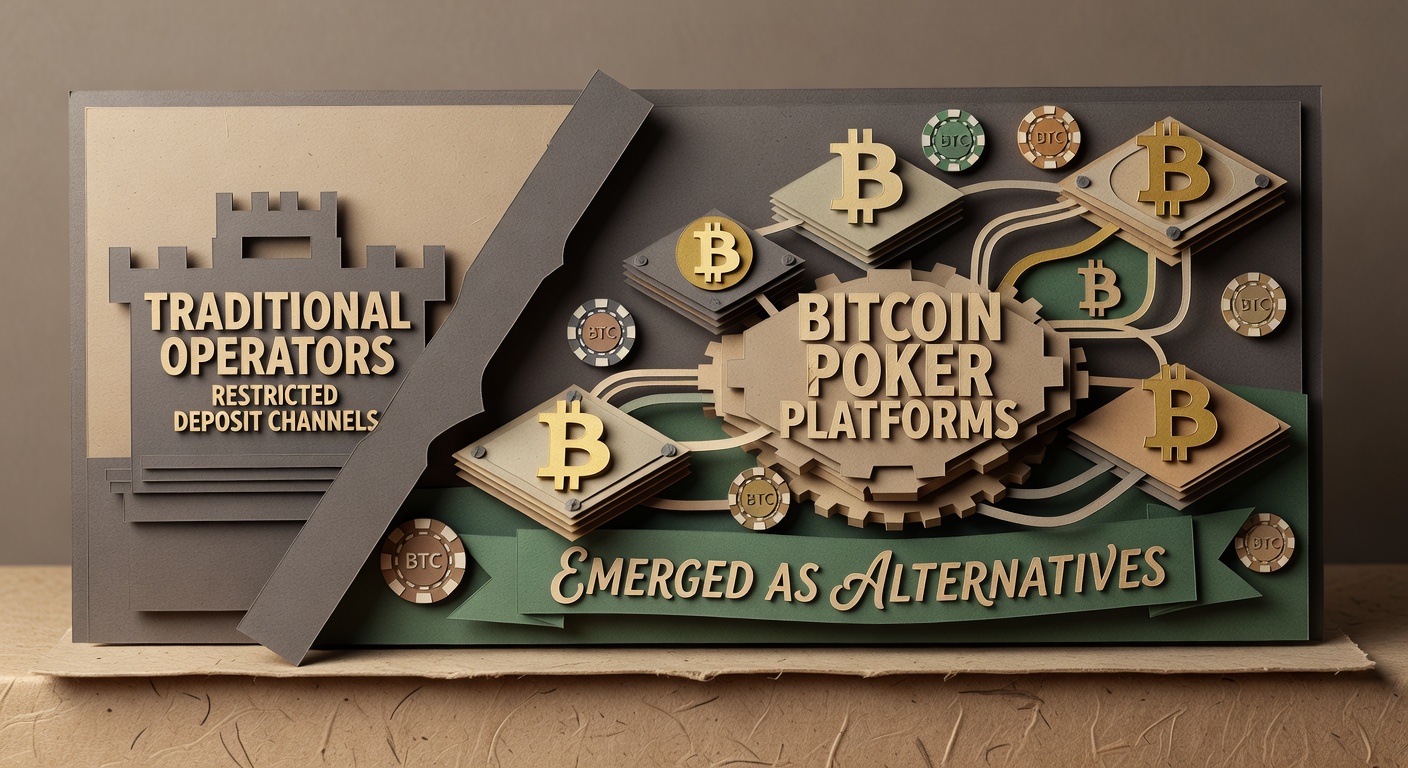
See, in the United States after Black Friday in 2011, a lot of states basically said online poker is illegal. But they also made it illegal for banks to process payments to poker sites. So if you wanted to play online poker legally in the US, you literally could not fund your account because your bank would not move the money. But Bitcoin does not require a bank. The money goes from your wallet to the poker site's wallet. No bank is involved. No one is asking your bank to freeze the transaction.
This is where crypto for poker makes sense. Not because crypto is better money (it is actually worse money, more volatile, less stable). But because crypto does not require permission from a centralized authority. A bank can say no. Bitcoin says yes.
How the Mechanics Actually Work
You set up a Bitcoin wallet (Coinbase, Kraken, whatever). You fund it with US dollars or euros or whatever currency you use. Then you go to a poker site that accepts Bitcoin. You copy their Bitcoin deposit address. You paste it into your wallet. You send the Bitcoin. Within 10 minutes to an hour, depending on network congestion, the Bitcoin arrives at the poker site and gets converted to poker chips. Or, more commonly these days, it stays as Bitcoin and you play in sats (satoshis, tiny fractions of Bitcoin).
Withdrawal is the same in reverse. You withdraw from the poker site to your Bitcoin wallet. Your wallet confirms the transaction. The Bitcoin lands in your personal wallet. Then you convert it to fiat currency on an exchange.
The friction points: You have to buy Bitcoin somewhere, which requires KYC (know your customer) verification on the exchange. The poker site still does KYC. So the anonymity thing does not actually hold. What you get is payment processing speed. Bitcoin clears faster than international wire transfers. That is the real advantage.
Volatility is the hidden cost. You buy Bitcoin at $50,000. You play poker for three days. Bitcoin drops to $45,000. Your poker bankroll just got 10 percent smaller through no fault of your own. Or Bitcoin rises to $55,000 and you are up money without playing well. Over time these swings average out, but in the short term they add noise to your results.
The tax question is brutal. If you are in the US, every crypto transaction is a taxable event. You buy Bitcoin for $1000. You send it to a poker site. That is a taxable event (you have established a basis). You play poker and win $200 in chips. The chips are worth $1200 total. If you withdraw those chips as Bitcoin and Bitcoin has gone up, the increase in value is taxable capital gains. If Bitcoin has gone down, you can take a loss. But the accounting is a nightmare.
The jurisdictional question is simple: If poker is illegal in your jurisdiction, using Bitcoin does not make it legal. What it does is make it harder for authorities to enforce. If you are in the UK, poker is legal and regulated, so using Bitcoin instead of a bank transfer does not change your legal status. If you are in the US, poker's legal status is state-dependent. Using Bitcoin does not change that either.
The sites themselves (Betonline, Unibet, others) accept Bitcoin for the same reason your credit card processor accepts it: it makes payments happen when traditional channels will not. They cannot offer poker without payment processing. Bitcoin is the workaround.
The honest answer: Crypto for poker is useful if you are in a jurisdiction where the banks will not process poker payments, and the poker site is reputable. Otherwise, it is an unnecessary complication. You are paying transaction fees (Coinbase charges 1.49 percent to buy Bitcoin, the poker site might charge another 1 percent to convert it). You are exposing yourself to volatility. And you are creating a detailed tax record of every transaction.
The guy in Puerto Vallarta, he was in a jurisdiction where poker is illegal and banks were watching him. For him, Bitcoin made sense. For most people, a bank transfer is simpler and cheaper.